← Back to the work
Prototypes • AI Systems & Narrative Intelligence

Can storytelling instincts become software?

After years of finding the story inside complicated things, I wondered if the instinct itself could be modeled.

Not the writing. The judgment that comes before it.

What matters? What's missing? What's emerging?

So I broke the instinct apart.

01 Tool 1

What matters?

Matter Meter

What's worth paying attention to?

Matter Meter interface
Matter Meter
02 Tool 2

What's missing?

Story Gap Mapper

What's not being said?

Story Gap Mapper interface
Story Gap Mapper
03 Tool 3

What's emerging?

Story Signal

What's starting to take shape?

Story Signal interface
Story Signal
04 Integration

Then I put them together.

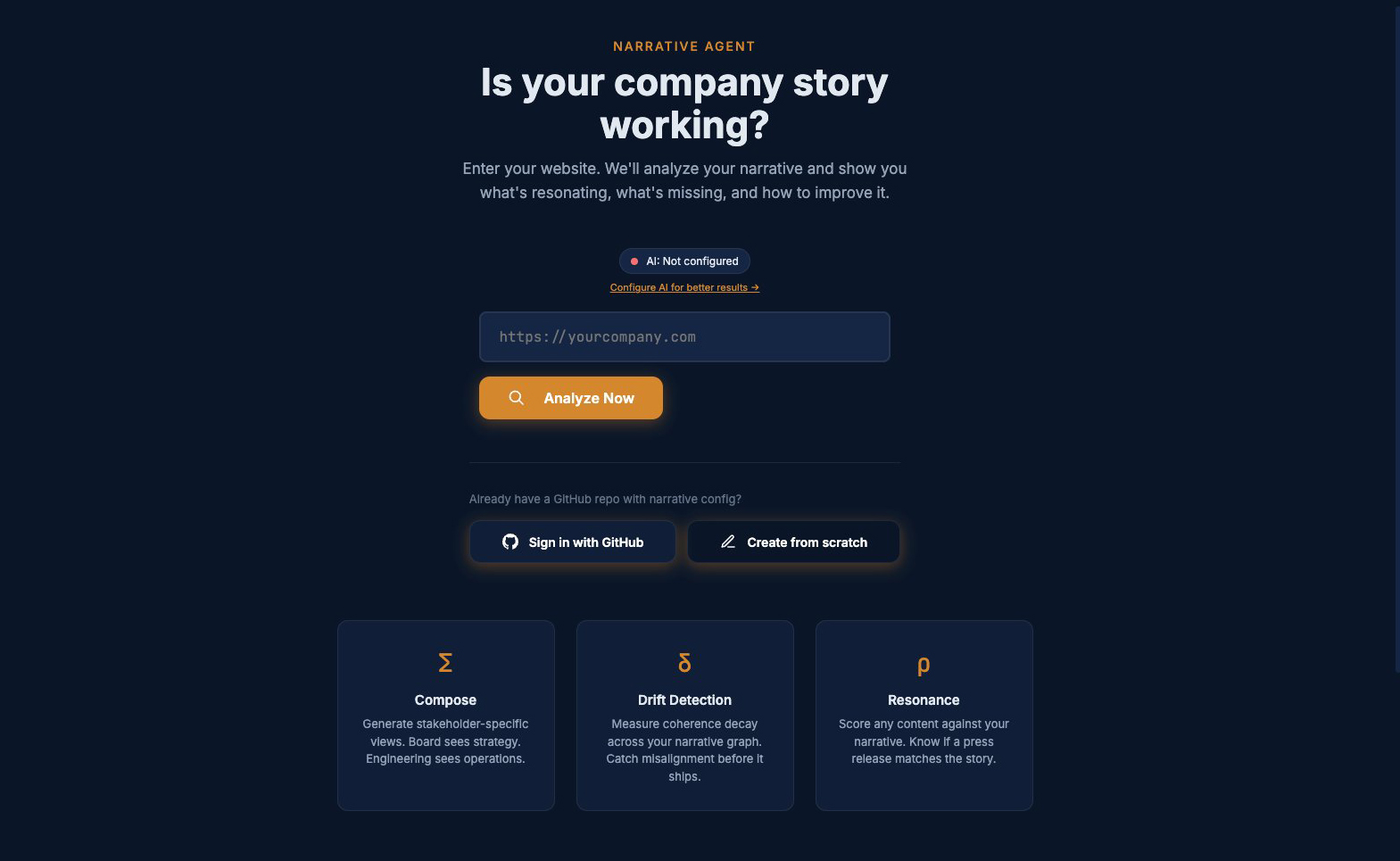
Narrative Agent

But there was still a problem.

A story doesn't live in one place. It's in the strategy, the product, what customers are saying, what the numbers prove, and what the company is saying out loud.

And those things are connected.

So what if the story knew it was connected?

Narrative Agent breaks narrative into units and maps the relationships between them. Change something in one place and you can see what it affects somewhere else.

Now you can ask: Does this still hold up? What broke? What's missing? Where did we drift?

I call it narrative algebra.
05 Impact

Why it matters

Organizations don't have a shortage of content.

They have websites, decks, research, executive talking points, product messaging, employee communications, customer stories, strategy documents, transcripts, launches, and thousands of other fragments.

The problem is seeing the story across all of it.

The Questions That Matter

Where are we aligned?

Where are we contradicting ourselves?

What are we saying without proving?

What do we know that we're not saying?

What changed?

And what should the story become next?

That's the problem Narrative Agent is designed to explore.